26.Text Processing in NLP

Text Processing (also called Text Preprocessing) is the first and most important step in Natural Language Processing (NLP).
Text Processing is the process of cleaning and preparing raw text so that computers can understand and analyze it.
Human language contains noise such as symbols, spelling mistakes, emojis, and extra words.
Machines cannot understand this directly — so we clean it step by step.
Why Text Processing is Needed
Human text contains:
Capital letters
Symbols (!, ?, #)
Extra words (is, am, the…)
Different word forms (playing, played)
Consider this sentence:
“I’m VERY happy today!!!”
Humans understand emotion instantly.
Computers see only characters.
Complete Text Processing Pipeline
#Text Cleaning
What happens here?
We remove:
Capital letters
Punctuation
Numbers
Special characters
HTML tags
Everything is converted to lowercase.
Example:
Original:
I’m VERY happy today!!!
After cleaning:
Im very happy today
This cleaned corpus is now ready for tokenization.
That is Text Cleaning removes noise from raw text.
#Tokenization
Tokenization = splitting sentences into individual words
Example:
im very happy today
Becomes:
[“im”, “very”, “happy”, “today”]
Each word is called a token.
Tokenization breaks text into words.
#Stop Words Removal
Some words appear very frequently but add little meaning:
is
am
the
and
very
These are called stop words.
Example:
[“im”, “very”, “happy”, “today”]
After removing stopwords:
[“happy”, “today”]
Stop word removal keeps only meaningful words.
#Stemming and Lemmatization
Now we reduce words to their base form.
In NLP, the same word can appear in many forms:
play, playing, played
history, historical
final, finally, finalized
If we treat all these as different, the computer gets confused.
So we convert them to a common base form.
That process is done using:
1. Stemming
2. Lemmatization
Both aim to reduce words, but they work differently.
Stemming :
Stemming is the process of cutting off word endings to get a root form (stem).
It does NOT care if the result is a real English word.
It simply chops letters.
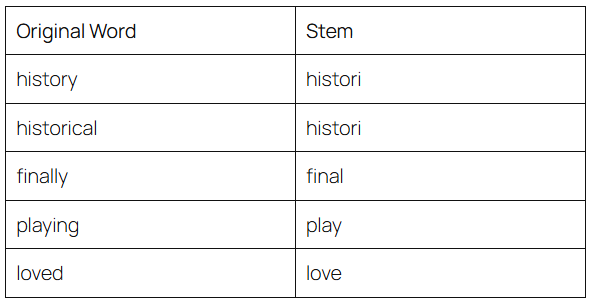
Output may not be grammatically correct. It is Fast, Simple, Output may be incorrect English.
Lemmatization:
Lemmatization converts words into their meaningful base form (called lemma).
It always gives a proper dictionary word.
It understands grammar and meaning.
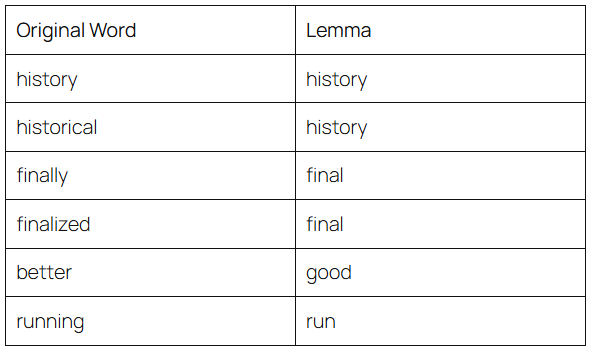
More accurate than stemming.
Stemming and lemmatization convert words to root form.
All results are real English words.
So, Lemmatization is Accurate, Meaningful, Slower than stemming
Main Difference:
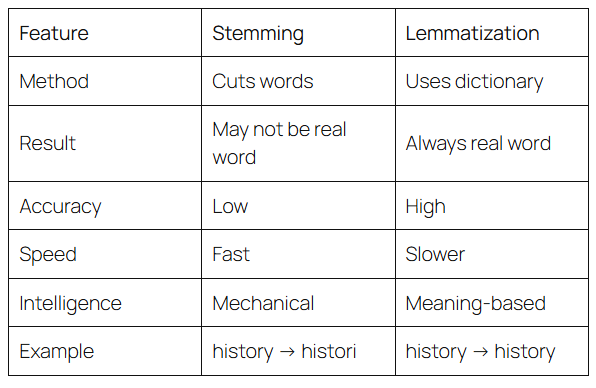
Simple Example
Sentence:
Finally the historical movie was better.
After stemming:
final histori mov better
After lemmatization:
final history movie good
#Handling Contractions
People write:
don’t
can’t
I’m
These are contractions.
We expand them:
don’t → do not
I’m → I am
Example:
im happy
Becomes:
i am happy
Contraction handling makes text clear and complete.
#Handling Emojis and Emoticons
Text may contain emojis:
We convert them into words.
Example:
happy
Becomes:
happy :grinning_face:
Emojis are converted into readable text.
#Spell Checking
People make spelling mistakes:
gud → good
happi → happy
Spell checking fixes this.
Example:
[“happi”, “tody”]
Becomes:
[“happy”, “today”]
Spell checking improves text quality.
Final Output After All Steps
Original:
I’m VERY happy today!!!
After full processing:
[“happy”, “today”]
Now this clean data is ready for:
Word Embeddings Machine Learning Sentiment Analysis
Comments
Join the discussionNo comments yet. Be the first to comment.


